
Standard Chartered on Friday lowered India's growth forecast for the current financial year to 4.7 per cent from earlier 5.5 per cent, citing "upside risks" to inflation and fiscal deficit.

Agriculture, which accounts for 14% of GDP grew at 3.2% in the quarter

From the Sensex pack, ITC, Titan, Asian Paints, Reliance, Tata Steel, Bajaj Finserv, Axis Bank, Hindustan Unilever, Infosys, Bajaj Finance, Nestle and ICICI Bank were the major gainers. Kotak Mahindra Bank, Mahindra & Mahindra, HCL Technologies, State Bank of India, Bharti Airtel and Tata Motors were among the laggards.

India's industrial production growth rose to a 14-month high of 10.3 per cent in August, mainly due to good show by the manufacturing, mining and power sectors, according to the official data released on Thursday. The factory output growth measured in terms of the Index of Industrial Production (IIP) had contracted by 0.7 per cent in August 2022. The previous high was recorded at 12.6 per cent growth in June 2022.

The investment climate is going well in India and the private sector should skill their workforce in the interest of its business, Chief Economic Advisor K V Subramanian said on Thursday asserting that he does not foresee any difficulty in demand and supply of the workforce. Addressing 'Times Network India Economic Conclave', Subramanian further said job creation is part of the virtuous cycle that starts with private investments flowing into the country resulting in production, growth, job creation and increase in aggregate demand which in turn leads to more investments in the economy. The investment climate is going well in India. Other things will follow, though with a lag...it is for the private sector to start recognising that it is in their own business interest that they should skill their workforce. This, in turn, will raise the average level of skills in India," he said.
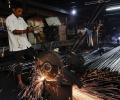
India's industrial production growth rose to a five-month high of 5.7 per cent in July, mainly due to good showing by the manufacturing, mining and power sectors, according to the official data released on Tuesday. The factory output growth measured in terms of the Index of Industrial Production (IIP) stood at 2.2 per cent in July 2022. The previous high was recorded at six per cent growth in February 2023. Thereafter, the growth rate declined to 1.9 per cent in March 2023 before rising to 4.6 per cent in April and further to 5.3 per cent in May.
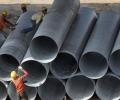
Industrial metals (ferrous and non-ferrous) suffered great volatility once the Ukraine War began in February 2022. First, there was a sharp price rise due to fears of supply disruption, followed by weak global demand. China's weakness and rolling lockdowns have hit production and demand.

Industrial production growth slowed down to five-month low of 0.4 per cent in August mainly due contraction in manufacturing output and lower offtake of consumer goods.
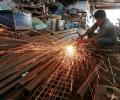
India's industrial production growth decelerated to an 8-month low of 2.4 per cent in November, mainly due to poor showing by the manufacturing sector, according to the official data released on Friday. The factory output growth measured in terms of the Index of Industrial Production (IIP) was 7.6 per cent in November 2022. The previous low of IIP growth was recorded at 1.9 per cent growth in March 2023.

Industrial production re-entered the negative territory by contracting 1.6 per cent in January, mainly on account of the decline in output of capital goods, manufacturing and mining sectors. The output of the manufacturing sector -- which constitutes 77.6 per cent of the Index of Industrial Production (IIP) -- shrank by 2 per cent in January, as against a growth of 1.8 per cent during the same month last fiscal, as per data released by the government on Friday. The worst performance was witnessed by the capital goods sector, which recorded a contraction of 9.6 per cent during the month under review, compared to a 4.4 per cent decline a year ago.
Industrial production surged by 13.6 per cent in June mainly due to a low-base effect and good performance by manufacturing, mining and power sectors but the output remained below the pre-pandemic level. The manufacturing sector, which constitutes 77.63 per cent of the Index of Industrial Production (IIP), grew by 13 per cent in June this year, according to the data released by the National Statistical Office (NSO) on Thursday. The mining sector output rose by 23.1 per cent in June while power generation increased by 8.3 per cent.
India's industrial production growth slowed down for a fourth straight month in December to 0.4 per cent mainly due to a poor performance by the manufacturing sector. The manufacturing sector, which constitutes 77.63 per cent of the Index of Industrial Production (IIP), contracted by 0.1 per cent in December, according to the data released by the National Statistical Office (NSO) on Friday. In December 2021, the mining output rose by 2.6 per cent, and power generation increased by 2.8 per cent.

FDI is a major driver of economic growth and a source of non-debt finance for the economic development of the country. The government has put in place an investor-friendly policy on FDI, under which investment up to 100 per cent is permitted on the automatic route in most sectors/ activities. At $ 64.37 billion, FDI in 2018-19 is the highest ever investment received for any financial year.

A reception often reserved for rockstars came the way of mining mogul Anil Agarwal when he started revealing nuggets of his ascent from a scrap-metal dealer to one of India's most prominent self-made industrialists on social media. And now he has been flooded with booking writing proposals and has even been offered money for a biopic. In February this year, Agarwal, 68, started tweeting his journey from Bihar to Mumbai first and then to London to head a globally diversified natural resources company with interests in zinc-lead-silver, iron ore, steel, copper, aluminium, power, oil and gas.

Indian companies are generating more cash than ever. The net cash flow from listed firms' operations hit a new high of Rs 11.1 trillion in financial year 2023-24 (FY24), crossing the Rs 10-trillion mark for the first time, according to the Centre for Monitoring Indian Economy (CMIE) data going back to 1990-91. The FY24 figure represents a 19.3 per cent jump over the previous year, even as quite a few companies are yet to release their numbers.
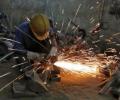
Industrial production in May slowed to 2.7 per cent from 5.6 per cent a year ago, dragged down by manufacturing, strengthening the case for an RBI rate cut.
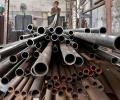
On June 30, mining and metals giant Vedanta, announced that it had decided to initiate a strategic review of its steel and steel-making raw material businesses. The review would begin immediately and evaluate a broad range of options, including but not limited to a potential strategic sale of some or all of the steel businesses, the company said in its stock exchange filing. The signs have been there - approaches had been made to steel players over the past year. Last December, Anil Agarwal, chairman Vedanta group, told Business Standard that the steel plant capacity was about 3 million tonnes (mt).

Indian industry has logged a growth of 9.5 per cent in April 2006 as against 8.1 per cent in the same month last fiscal.
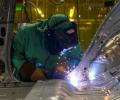
There was a slowdown in the manufacturing sector, which grew at 1.2 per cent in June 2019 as compared to 6.9 per cent a year ago.

The World Bank has retained India's economic growth forecast for the current fiscal at 8.3 per cent as the recovery is yet to become broad-based. As per the first advanced estimates of the national income released by the National Statistical Office (NSO) last week, the economy is projected to grow at 9.2 per cent in 2021-22, surpassing pre-COVID level in actual terms, mainly on account of improved performance, especially in farm, mining and manufacturing sectors. "India's economy is expected to expand by 8.3 per cent in fiscal year 2021/22 (ending March 2022), unchanged from last June's forecast as the recovery is yet to become broad-based.
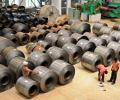
The mining sector grew by 4.3 per cent in June as against a dip of 4.6 per a year ago.

A bill to auction coal mines is also likely to be passed later.
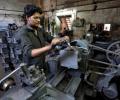
India's industrial production growth rose marginally to 5.6 per cent in February from 5.5 per cent in January 2023, mainly due to good performance of the power, mining and manufacturing sectors, according to official data released on Wednesday. There was an improvement on an annual as well as sequential basis. The factory output growth measured in terms of the Index of Industrial Production (IIP) stood at 1.2 per cent in February 2022.

The Adani family, led by Chairman Gautam Adani, is the most valued first-generation family business at Rs 15.44 trillion.

A ramp-up in COVID-19 vaccination, healthy advance estimates of kharif (summer) crop and faster government spending were the factors which led to the revision, the agency said in a statement. It can be noted that after the 7.3 per cent contraction in 2020-21, there were expectations of a higher growth number in 2021-22.

India's economic growth slowed to 8.4 per cent in the second quarter of 2021-22, mainly due to waning low base effect, official data showed on Tuesday. The GDP growth in April-June quarter this fiscal stood at 20.1 per cent. The Indian economy had contracted by 24.4 per cent in April-June last year.

'Make your child solve his/her problems on his/her own. Let the child see parenting as a partnership between you and your child.'
.jpg)
The marginal improvement in the index of industrial production was mainly on account of higher power generation and mining sector output, while manufacturing declined.

The IIP data showed a significant slowdown in the manufacturing sector, which grew at 4.2 per cent in July 2019 as compared to 7 per cent a year ago.

'The answer for a quicker boost to growth is simple -- run a much larger deficit, use the resulting public resources to ensure adequate price support for agriculture, subsidise wage costs of MSMEs and accelerate public sector construction-intensive activities,' advises Nitin Desai.
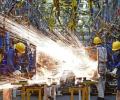
Industrial production declined by 10.4 per cent in July, mainly due to lower output of manufacturing, mining and power generation, as per the government data released on Friday.

The earnings are, however, expected to be down around 2 per cent on a sequential basis due to pent-up demand getting exhausted and the adverse impact of rising metals and energy prices on consumer goods and manufacturing companies.
Pulled down by the mining and electricity sectors, the Index of Industrial Production stood at 8.8 per cent during April 2005 compared to 8.9 per cent in the same month last year.

New investors should gradually build a 5 to 10 per cent allocation to gold.

As many as seven of eight core industries saw a contraction in output in September.
Although the mining and electricity sectors did better in May, manufacturing fared poorly in the month with the growth rate decelerating to 11.9 per cent from 13.3 per cent during the corresponding month in 2006-07.

India's economic growth slowed to 3.1 per cent in January-March and to an 11-year low of 4.2 per cent for the full fiscal 2019-20 amid a drop in consumption and investment. The Gross Domestic Product (GDP) growth stood at 5.7 per cent in the corresponding quarter of 2018-19, according to data released by National Statistical Office (NSO) on Friday.
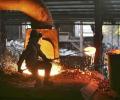
India needs to revive corporate sector investment, push critical reforms and remove infrastructural bottlenecks to boost industrial growth in the country, says a government document.

The first economic readings to be published in 2015 will be out on Monday, when the government releases industrial output data for November and the consumer price index for December.

'The ruling does not automatically mean that your house can be taken away, but suppose it blocks an expressway or a highway or such essential development, then it can be taken away as long as there is a law to support that action.'
